
When Death Is Not Enough: Underreported Mortality in Cambodia’s Scam Compounds

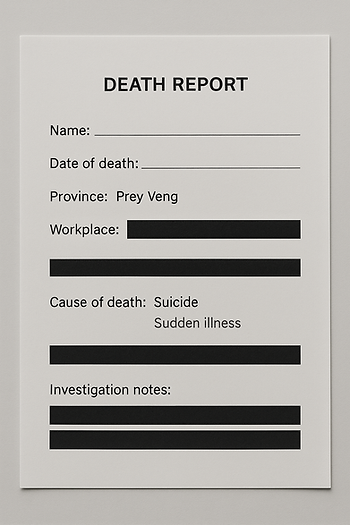
Deaths linked to Cambodia’s scam compounds are not rare anomalies. They are frequent, patterned, and severely underreported. What appears in official records represents only those cases that produce a body, documentation, and sufficient administrative evidence to be processed. Many more disappear before reaching that threshold.
The underreporting is structural. It stems from evidentiary absence, controlled environments, and administrative practices that treat death as paperwork rather than an event requiring inquiry. In this system, if evidence is incomplete, inaccessible, or inconvenient, the death simply does not exist.
Administrative Processing Without Investigation
When deaths are acknowledged, they follow a fixed bureaucratic sequence. Local police issue brief reports. Bodies are transferred to provincial hospitals and then to the national morgue in Phnom Penh. Families receive standardized death certificates listing generic causes: sudden illness, respiratory failure, cardiac arrest, suicide, or unspecified medical complications. Autopsies are uncommon. When conducted, they rarely extend beyond surface examination. Case files contain no investigative notes, no reconstruction of events, and no examination of working or living conditions.
The documentation closes the case procedurally while leaving factual questions unresolved.
Public reporting mirrors this administrative minimalism. When deaths appear in media or social platforms, they are described in short Chinese-language posts that state a cause and a general location, often accompanied by phrases such as “no suspicion of foul play.” The language creates an illusion of clarity without describing circumstances. Follow-up reporting is rare. Formal investigative outcomes are almost never published.
Deaths That Never Enter the Record
Testimonies from former workers inside scam compounds indicate that recorded deaths represent only a portion of actual mortality. Accounts describe punishment rooms, prolonged deprivation, untreated injuries, and bodies removed at night to areas behind compound perimeters. These deaths leave no physical evidence accessible to authorities. Without a recovered body, no administrative process begins. The absence of evidence becomes the basis for nonexistence.
In such cases, death is not denied; it is administratively invisible.
Normalisation Through Repetition
Even acknowledged deaths occur frequently enough to become routine. Notices describing foreign nationals found dead in guesthouses, apartments, or roadside locations appear briefly and then recede. The repetition normalizes the events. Language remains uniform across cases, reducing the likelihood of scrutiny. In other jurisdictions, a single unexplained death might prompt inquiry. Here, the pattern itself discourages investigation.
Many of these deaths trace back to sealed compounds operating in remote or privately controlled zones. Outwardly presented as office buildings or business parks, they function as restricted environments where movement is controlled and labour is enforced. Bodies removed from these sites are recorded administratively rather than examined for cause. Unless external attention has already been drawn to a case, no independent forensic review occurs.
In several provinces, families reported visible injuries inconsistent with listed causes of death. These discrepancies reflect a broader pattern in which classifications are adjusted to align with institutional interests. References to scam operations are omitted. The word “scam” does not appear in death certificates. Causes are framed as medical or personal, insulating the operating environment from scrutiny.
The Case of Lin Shaodong
On 21 November 2025, the family of Lin Shaodong, a Chinese national from Hunan province born in 1986, received a death notification through consular channels. The document stated that Lin had died on 18 October 2025 after “jumping from the fourth floor of a building” in Prey Veng province. The case was classified as suicide. No investigative notes accompanied the notification. His remains were transferred to Teuk Tla temple pending family arrangements.
Lin had entered Cambodia legally in May 2025. During his time there, he contacted his sister only twice. He did not disclose where he was working or under what conditions. After receiving the death certificate, his sister began searching for information, relying solely on the administrative conclusion provided.
She posted an appeal on Xiaohongshu seeking information about her brother. Shortly afterward, she received a call from Chinese authorities instructing her to delete the post, citing concerns that it would “affect the image of the Chinese embassy in Cambodia.” No additional information was offered. The post was removed.
Subsequently, she turned to Telegram and posted another appeal. A response came from an individual who identified himself as Lin’s former colleague. This person stated that Lin had been working at #8 Park, also known as Legend Park, a compound in Prey Veng widely referenced in survivor testimonies and Chinese-language forums as a closed scam center. The location matched the province listed on the death certificate, which named Prey Veng but provided no further detail about the building or its function.
When Lin’s body was transferred to the temple, a photograph was obtained for the family. Injuries around the eyes and mouth appeared different in coloration from the injury on the forehead. To his sister, the pattern raised questions about whether the injuries were consistent with a single fall or suggested earlier mistreatment. The embassy documentation did not address injuries. It contained only the suicide classification and instructions for repatriation.
No public investigation followed. No supplementary report was issued. Online appeals circulated briefly and then disappeared. The administrative record concluded the case.
A Pattern, Not an Exception
Lin’s death is not an isolated incident. Since the beginning of our documentation efforts, at least six similar death cases have been identified involving Chinese, Malaysian, and Vietnamese nationals. In each case, death certificates provided generic causes and omitted any reference to scam operations or working conditions. Families were instructed to collect the bodies. Many lacked the financial means to do so. Without repatriation, follow-up, or advocacy, the cases disappeared.
Once again, the scam centers resumed operations. The system absorbed the deaths. The absence of investigation became closure.
In this environment, death does not interrupt the machinery. It is processed, minimized, and forgotten. The lack of evidence is not accidental; it is produced by closed environments, controlled reporting, and administrative practices that prioritize procedural completion over truth.
When death requires proof to exist, and proof is structurally denied, mortality becomes undercounted by design. In such systems, death is not enough.


